
The availability of reliable ground-truth data is one of the main bottlenecks for improving high-resolution forest attribute maps from Earth observation data. This is underpinned by the European Union (EU) Forest Strategy for 2030 that underscores the need for harmonized, cross-border forest resource assessments that integrate both remote sensing and field-based National Forest Inventory (NFI) data. However, confidentiality constraints on NFI plot coordinates present a significant barrier to aligning these datasets, thereby limiting the development of unified forest monitoring systems that can fully leverage the potential of Earth Observation data. To overcome these data-sharing limitations we explored the effectiveness of a privacy-enhancing technique, known as Federated Learning (FL), that is a form of distributed computing aimed at preserving the privacy and confidentiality of data owned by different organizations. This methodology has been tested for the collaborative modelling and mapping of forest timber volume across four European countries: Norway, Sweden, Finland, and Italy.
We employed a time-series convolutional neural network (CNN) architecture tailored to integrate 40 years of Landsat or 7 years of Sentinel imagery and terrain variables with harmonized NFI data from more than 85,000 sample plots. This model architecture was used for the FL approach and compared to traditional country-specific and centralized modelling strategies.
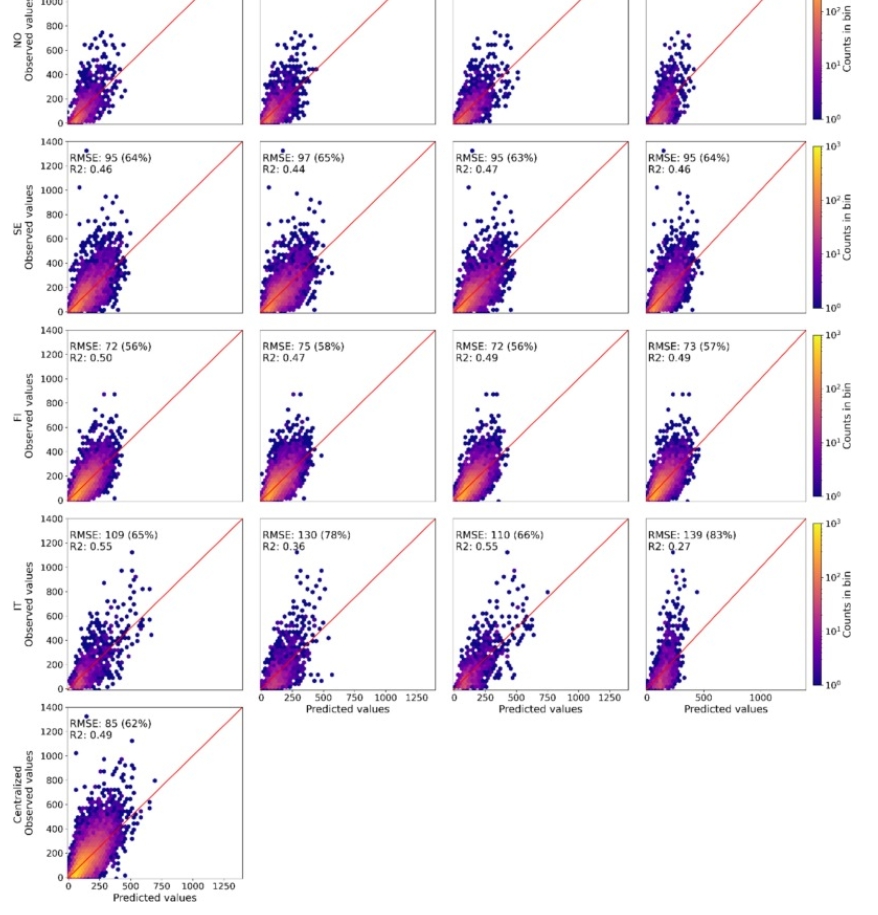
FL models achieved predictive performances comparable to the traditional models, which proofs the effectiveness of the proposed approach. Centralized or global models showed slightly reduced performance compared to the national models, highlighting the value of fine-tuning with local ground-truth data.
By aligning with the EU’s forest monitoring objectives, FL facilitates the generation of harmonized models and maps of forest features, like timber volume and biomass, that are critical to support evidence-based forest policy and management. The findings underscore the potential of FL to transform collaborative environmental monitoring, particularly in domains where data confidentiality and interoperability are critical.
Johannes Schumacher a, Alessandro Cescatti b, Gherardo Chirici c, Giovanni D’Amico c, Saverio Francini d, Johannes Hertzler e, Lauri Mehtätalo f, Gert-Jan Nabuurs g, Mats Nilsson h, Juho Pitkänen f, Johannes Breidenbach aa
NIBIO, Norwegian Institute of Bioeconomy Research, National Forest Inventory, NO-1400 Ås, NorwaybEuropean Commission, Joint Research Centre (JRC), Ispra, ItalycUniversity of Florence, Department of Agricultural, Food, Environmental and Forestry Sciences and Technologies (DAGRI), Via San Bonaventura 13, IT-50145 Florence, ItalydUniversity of Bologna, Department of Agricultural and Food Sciences (DISTAL), Viale Giuseppe Fanin, 40-50, IT-40127 Bologna, ItalyeThünen Institute of Forest Ecosystems, Alfred-Möller-Straße 1, Haus 41/42, Eberswalde 16225, GermanyfNatural Resources Institute Finland (LUKE), Bioeconomy and Environment Unit, Yliopistokatu 6 B, FI-80100 Joensuu, FinlandgForest Ecology and Management Group, Wageningen University, Droevendaalsesteeg 3, 6708 PB Wageningen, the NetherlandshSwedish University of Agricultural Sciences, Department of Forest Resource Management, SE-901 83 Umeå, Sweden